Fabric cleaning codes, and why they decide everything
There is a tag under your cushion with a single letter on it. That letter determines whether your furniture survives being cleaned.
Calls answered 7am to 8pm · same-day service usually available
Send a photo of the tag and we will tell you what it means before you book anything.
The four codes
| Code | Means | What happens if you get it wrong |
|---|---|---|
| W | Water-based cleaning is safe | Forgiving, though over-wetting still causes wicking and slow drying |
| S | Solvent only, no water | Water causes rings, browning or dye movement, usually permanent |
| SW | Either is safe | The most flexible case and the easiest to work with |
| X | Neither, vacuum only | Any wet method risks shrinkage or color loss with no way back |
Where to find it
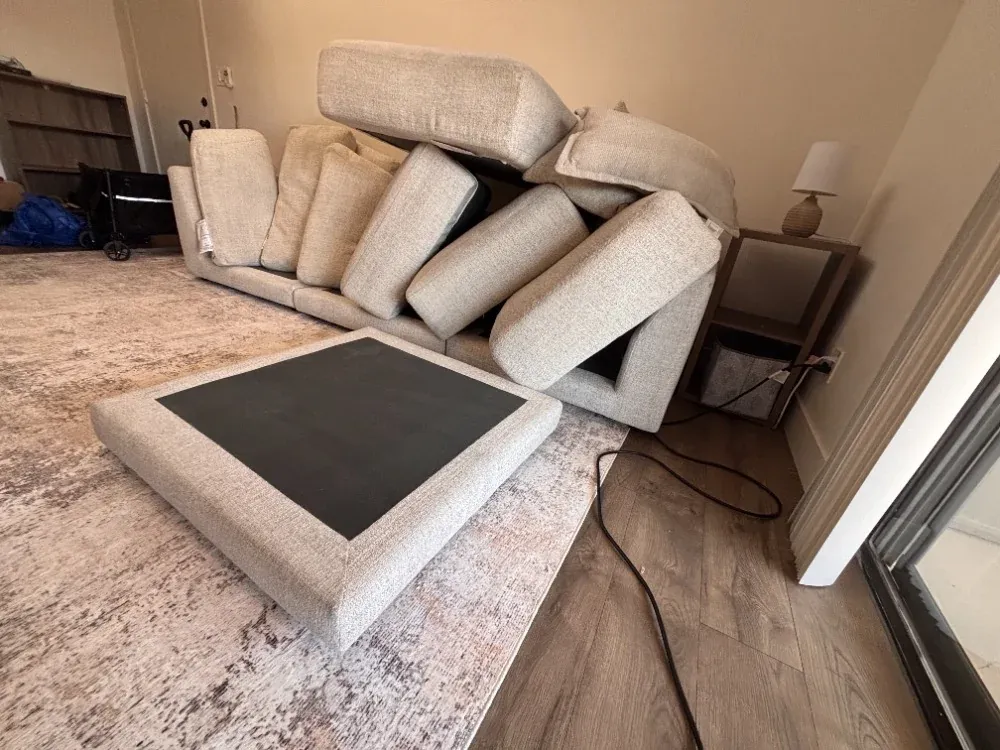
Lift a seat cushion and look underneath, check the frame below the piece, or look under the skirt at the back. On a sectional there is often a single tag covering the whole set.
It is a small printed tag, generally beside the fiber content and a fire safety notice. The letter is the part that matters and it is easy to skip past because everything around it looks like boilerplate.
What actually goes wrong
Browning
The failure nobody has heard of and the one responsible for the most grief. Particular fibers hold compounds that dissolve on contact with water, then travel outward with the moisture as the piece dries and oxidize once they reach the surface.
It looks like a stain and is not one. It is a reaction inside the fiber itself, which is why it cannot be cleaned off afterward and why it appears a day later once everyone has gone home.
Water rings
Wet an S-coded fabric in one place and the boundary between wet and dry dries at a different rate, leaving a visible edge. Frequently more obvious than whatever you were trying to remove.
Shrinkage
The reason X exists. Some fabrics contract when wetted and on a piece where cloth is stretched over a frame there is nowhere for that to go. Puckered seams, or a cover that no longer fits its insert.
Dye migration
Pigment travelling where it has no business going. A dark cord bleeding into pale cloth, a printed pattern going soft at its boundaries. Older pieces are the usual candidates and there is no route back from it.
When the tag has gone
It happens regularly in the historic streets and in central Chandler, where a piece may have had twenty-five years of covers coming off and going back on.
What we do then is slow and deliberate. Identify the fiber by hand and by behavior. Test in a concealed area, usually under a cushion or on the back of a skirt. Start with the gentlest method that stands a chance and escalate only if the test says it is safe.
Why this matters more than anything else here
Every other decision in this job is recoverable. A piece that does not come as clean as hoped can be cleaned again. A stain that will not lift is still a stain and nothing is worse.
Getting the method wrong is the one mistake with no way back. A shrunk cover, a browned arm or a bled seam is permanent.
Which is why we would rather turn down an X-coded piece than clean it. Telling you your furniture cannot be wet-cleaned costs us $150 and saves you a sofa, and in a town where we live among our customers that is not a difficult calculation.
Questions
Where is the cleaning code?
Usually on a tag under a seat cushion or fixed to the frame beneath the piece. Lift a cushion and look underneath, or check under the skirt at the back. On a sectional there is often one tag for the whole set.
What if there is no tag?
Common on older furniture, which describes a lot of what we see in the historic streets. We identify the fiber by hand and by how it behaves, test in a concealed area, and start with the gentlest method that could work.
What goes wrong with the wrong method?
Shrinkage, browning, water rings and dye movement, depending on the fabric. Most of it permanent. Browning is a reaction inside the fiber rather than a stain on it, so it cannot be cleaned off afterward.
Is X really vacuum only?
Yes. X means the manufacturer is saying neither water nor solvent is safe, usually because of shrinkage or unstable dye. Anyone offering to wet-clean one is either not reading the tag or ignoring it.
Does the code cover the whole piece?
Generally, though contrast welting, a different fabric on the back or a decorative pillow in another material can behave differently. We check anything that looks like a different cloth.
Would you ignore the code if I asked?
No. It is the manufacturer telling you what the fabric was built to survive, and we would rather lose the job than ruin a sofa on request.
Calls answered 7am to 8pm · same-day service usually available
Sofa $127.50, Sectional $297.50. Code read before anything starts.